
Top Signs You Need Garage Door Service – Don’t Ignore These
The top signs you need garage door service are a door that moves slower than it used to, grinding or popping noises, a door that sits uneven when partway open, visible cable fraying, and any door that closes on the second or third try. These aren’t quirks to live with. They’re specific mechanical signals with predictable failure timelines. Catching them early usually means a repair; waiting usually means a replacement. If you’d rather not crawl around with a flashlight yourself, call (833) 762-4168 for a free estimate.
A garage door that takes three seconds longer to open than it used to isn’t aging gracefully. It’s telling you the springs are losing tension, and if that’s what’s happening, one of them has roughly 60 days before it snaps under load. That’s the thing about garage doors in Palm Bay: they don’t fail without warning. They warn you for weeks. Most homeowners just normalize the warnings because they happen gradually.
The Slow Door Test – What a 20% Slowdown Actually Means
A garage door that opens noticeably slower than it did six months ago is usually showing spring fatigue or a struggling opener motor, and both get worse with every cycle. Here’s how to benchmark it so you’re not guessing.
Time your door from fully closed to fully open with your phone’s stopwatch. Do it three times and average the result. Write that number down. A healthy residential door running on a chain or belt opener covers its travel in a consistent time, cycle after cycle. Check it again in a month.
If your door is now taking 20% longer than it did, you’re looking at one of two things:
- Spring fatigue. Torsion and extension springs lose tension as they age. As they weaken, the opener has to work harder to lift the same weight. That’s the slowdown you feel.
- Opener strain. A motor that’s compensating for weak springs runs hotter and wears faster. If the opener is the only thing holding the door up, its lifespan drops fast.
In our experience around Palm Bay, a door that’s slowed down but still opens is the most commonly ignored warning we see. It’s also the easiest to fix before it becomes a snapped spring and a door stuck in the down position. Springs are the most dangerous part of any garage door, and they’re the part a trained technician should handle. We offer garage door spring repair as a dedicated service for exactly that reason.
What Each Noise Is Telling You
Grinding means roller wear, rattling means loose hardware, and a sharp pop means spring stress. Each sound maps to a specific part and a rough timeline, and the faster you match the noise to the part, the less you spend.
Grinding
Metal-on-metal grinding usually points to worn steel rollers or dry, failing bearings. Steel rollers flatten over time and stop rolling, which means they start dragging. Left alone, that drag transfers stress to the hinges and the opener. This one tends to get loud before it gets expensive, so it’s a good early catch.
Rattling
Rattling is loose hardware: hinge bolts, track brackets, the opener rail. It’s usually the cheapest fix on this list, but loose hardware vibrates, and vibration loosens everything around it. A rattle that’s been there for months is a rattle that’s been working its way into the track alignment.
Popping
A pop or a bang is spring stress, and it’s the one to take seriously. Torsion springs under load can snap without much further warning. If you hear a pop and then the door suddenly feels twice as heavy, stop operating it and call. Don’t try to lift it yourself. That’s the moment where a technician with the right winding bars and the right training earns their keep. Our technicians have up to 13 years of experience and know exactly how a stressed spring behaves before it fails.
The Asymmetry Test – When Your Door Sits Crooked
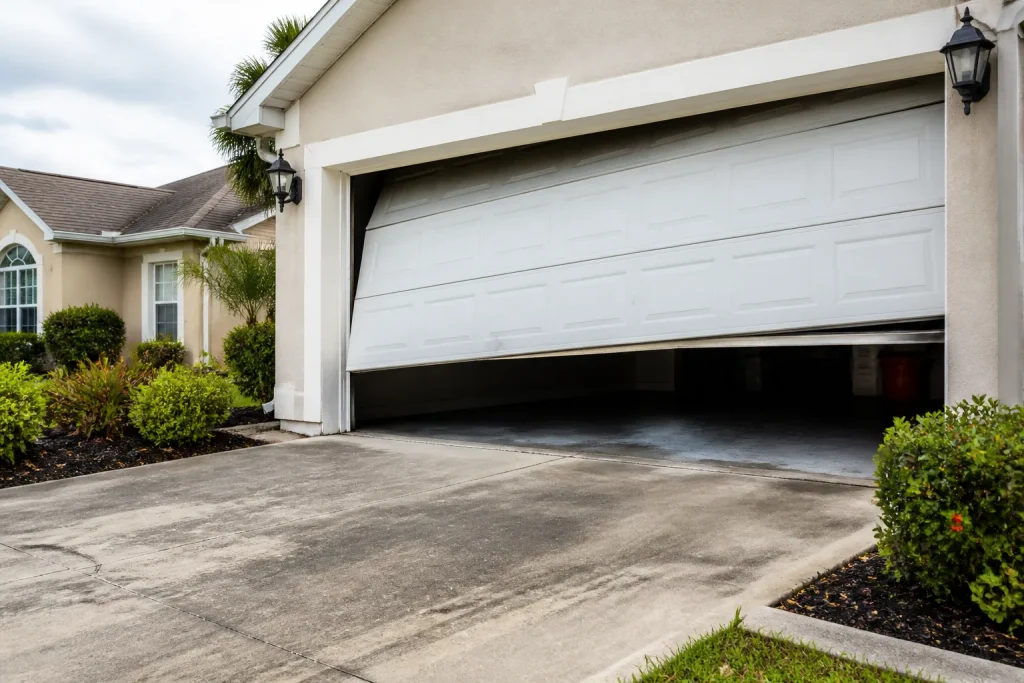
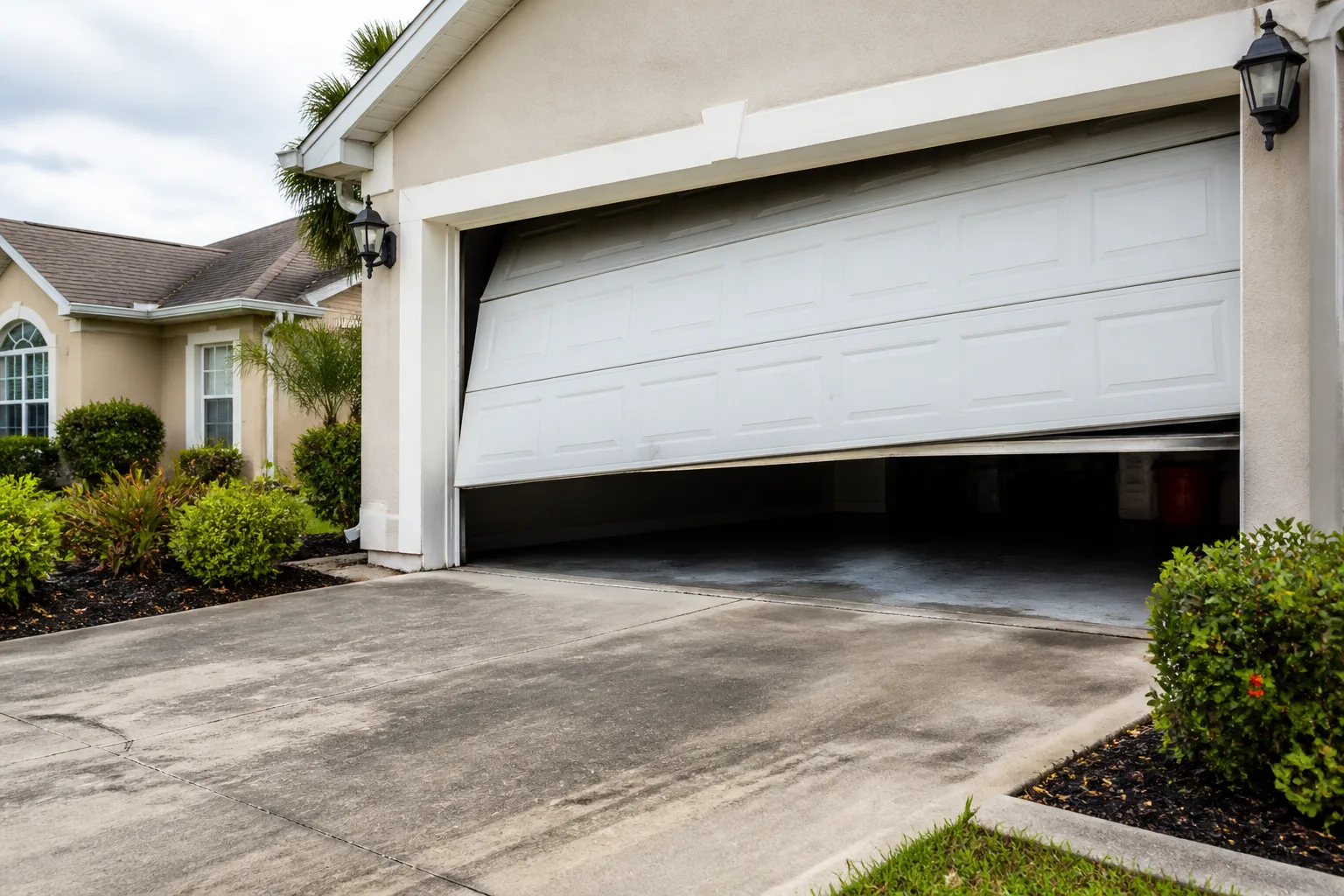
A door that sits higher on one side when it’s partially open has a balance problem, and that imbalance accelerates wear on the opener motor every single time you use the door. This is the test most homeowners never run.
- Open the door about halfway and stop it.
- Stand back and look at the gap between the bottom of the door and the floor on each side.
- If one side is higher by more than an inch, you’ve got an imbalance.
Imbalance comes from a stretched or broken cable, a spring that’s lost tension on one side, or a track that’s out of alignment. The door itself might still open and close, which is why people ignore it. But the opener motor is now lifting uneven weight on every cycle, and the rollers on the low side are taking extra load.
Left alone, that imbalance typically shortens the life of the opener and can warp the door panels over time. On a Clopay or Amarr sectional door, a warped panel means replacing sections rather than repairing hardware. That’s the difference between a tune-up and a bigger bill. Catching it early is worth it.
Visual Inspection Points You Walk Past Every Day
Cable fraying, bottom seal gaps, and hinge stress cracks are the three visual warnings homeowners miss most, and all three are visible in under two minutes with a flashlight.
- Cable fraying. Look at the lift cables on each side of the door. A healthy cable is smooth and tightly wound. Frayed strands, kinks, or a cable that looks like it’s unwinding are a serious safety concern. Don’t touch it. Cables are under extreme tension and can cause severe injury. Call a professional.
- Bottom seal gaps. A garage door seal that’s cracked, torn, or missing chunks lets in water, insects, and small pests. In Palm Bay’s humid months, that gap also invites moisture into the garage. It’s a cheap fix that prevents a much more annoying problem.
- Hinge stress cracks. Check each hinge where it mounts to the door panel. Hairline cracks radiating from the screw holes mean the hinge is pulling out. That’s usually a sign of vibration or imbalance elsewhere in the system, not just a bad hinge.
On a Wayne Dalton or Genie system, the cables and hinges are usually the first things to show wear, and both are easy to replace if you catch them before the door itself gets damaged. If you’re not sure what you’re looking at, a free estimate is a good excuse to have someone check.
Why Intermittent Problems Are More Urgent Than Constant Ones
A door that sometimes doesn’t close on the first try is more urgent than one that never closes, because intermittent behavior usually means a component is on the edge of failing completely. A consistent problem is already broken. An intermittent one is still working, just barely.
Common causes of a door that only sometimes fails:
- A safety sensor that’s misaligned or has a loose wire connection
- A limit switch on the opener that’s drifting out of adjustment
- A spring or cable that’s stretching and catching under certain loads
Each of these can go from “sometimes” to “not at all” without warning. And a door stuck open is a security problem; a door stuck shut traps your car. When the door won’t move, we do. Emergency garage door service is available for exactly these situations, with fast dispatch from 7am to 7pm, Sunday through Friday. We answer 24/7, and a call outside dispatch hours is booked into the next opening.
When to Call a Pro
Call a professional for anything involving springs, cables, or the opener motor’s electrical components. Those are the parts where a mistake isn’t just expensive, it’s dangerous. Springs and cables store enormous energy, and a snapped cable or a spring that releases while you’re working on it can cause serious injury. We work on your brand whether it’s Genie, Chamberlain, or a LiftMaster system you’ve had for years, and we’re comfortable with both the mechanical side and the electronics.
For a grinding roller, a loose hinge, or a worn seal, a visual inspection and a call to us is the right first step. We can look at the garage door repair options and tell you whether it’s a fix or a replacement. If the opener is the problem, we also handle garage door opener repair separately.
Related services in Palm Bay: spring repair, opener repair, panel and roller replacement, and full door installation when repair isn’t the right call.
The Bottom Line
Your garage door has been telling you what’s wrong for weeks. The slow opening that points to spring fatigue. The grinding roller you’ve learned to tune out. The crooked gap you’ve walked past a hundred times. None of it is subtle; it’s just familiar. Catching these signals early usually means a repair. Ignoring them means a snapped spring, a burnt-out opener, or a full replacement.
If you’re in Palm Bay and need help, Palm Bay Garage Door Repair Co offers free estimates and upfront pricing. The price is quoted and agreed before any work starts, and the written estimate sets the final price. Call (833) 762-4168. We answer 24/7. Fast dispatch from 7am to 7pm, Sunday through Friday.
Working on your own door is a reasonable idea right up until you’re standing under a torsion spring with a wrench. That’s the moment most people decide the estimate was the cheaper option.
Frequently Asked Questions
You know if the door moves noticeably slower than it used to, makes grinding or popping noises, sits uneven when partway open, shows frayed cables or cracked hinges, or only closes on the second or third try. Any one of these is a reason to have it checked. Call (833) 762-4168 for a free estimate.
Usually yes, in the sense that it points to spring fatigue or opener strain, both of which get worse with use. A 20% slowdown compared to your door’s normal travel time is the point where we’d recommend having the springs and opener checked. Catching it early keeps a repair from becoming a replacement. Call (833) 762-4168.
A popping noise usually means spring stress, and it’s the one sound you shouldn’t ignore. A spring under load can snap without much further warning. Stop operating the door and call a professional. Don’t try to lift the door or adjust the spring yourself. Our technicians have up to 13 years of experience with this exact repair. Call (833) 762-4168.
Intermittent closing problems typically come from a misaligned safety sensor, a drifting limit switch, or a spring or cable that’s stretching and catching. Intermittent failures are more urgent than consistent ones because the component is on the edge of failing completely. If the door stays stuck, we can get it moving. Emergency garage door service is available, with fast dispatch from 7am to 7pm, Sunday through Friday. Call (833) 762-4168.
Written by the team at Palm Bay Garage Door Repair Co.
Need Garage Door Help?
Call Palm Bay Garage Door Repair Co - the local pro we connect you with is licensed and insured, here with fast help in Palm Bay.
(833) 762-4168